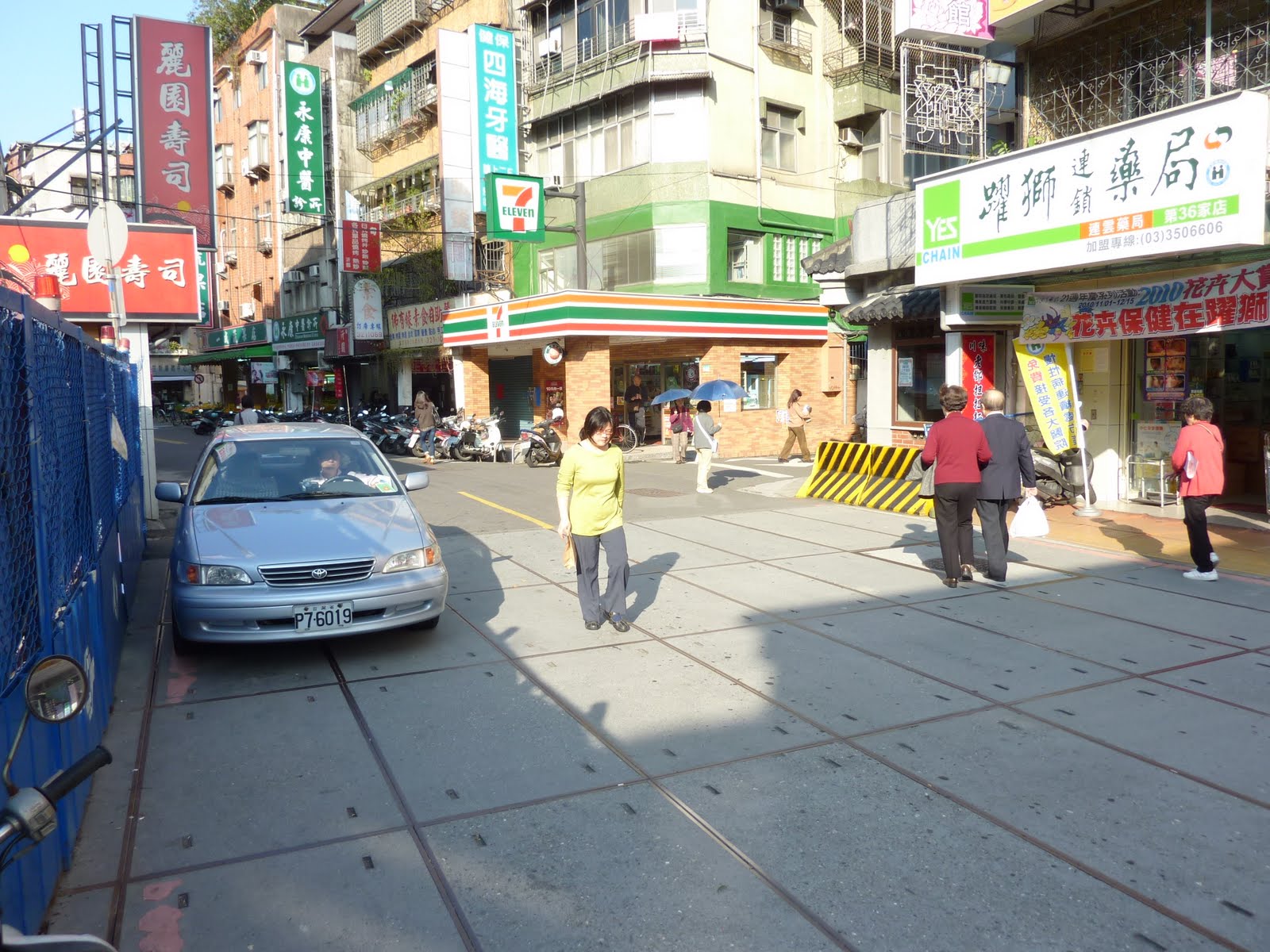
In April, Annmarie came to visit, and on Monday morning we got up early and went to the train station.
 We traveled for two hours, part of the time along the Pacific Ocean which is outside the window but you can't tell, to a city called Hualien on the east coast of Taiwan.
 Along the way I noticed some dry river beds coming out of the mountains, and before long it dawned on me that these would be filled with water at the times of the monsoon rains.
 At the train station we were met by a man who would be our driver and guide for two days. He didn't know us and we didn't know him, but he held a sign which had my name on it and so we got "connected".
 This is his yellow taxi, the kind you see all over the island.
 Our first day was spent at Taroko National Park, also referred to as Taroko Gorge. This is the gate at the entrance of the park.
 Our next stop was at the Shakadang Trail. Our guide didn't speak too much English, but we got along fine, and he did a good job of choosing interesting places to visit.
 This trail (as viewed from a red bridge) is carved out of the side of the mountain and goes several kilometers to where descendants of aborigines live. They get back and forth to their village by motorcycles on this trail and we were told to watch out for them. But we didn't see any until the very end when we saw a couple leaving from the trail head to go in.
  You have to watch out for low hanging rocks.
 Here you can see the red bridge as we make our return.
 We went part of the way, and then turned around.
 We next stopped at a shrine and temple where we were encouraged to drink the spring water.
 We went on several hikes this day, but we did not climb up to this temple.
 Instead, we walked over to this shrine and had a sip of the water.
 Farther up the mountain canyon we came to places where there was running water from the mountain springs. This place was called the Swallows Gorge because of the holes eroded in the rock by the rushing water of the monsoon rains, which might remind you of swallows nests.
 It was here that we were supplied with free helmets to protect us from falling rocks. (We didn't meet any.)
 Taxis, cars, tour buses and a few bicyclists travel this mountain road and go through the tunnels.
 Of course, when there is a cable bridge, you have to stop and cross it. Mom wasn't interested in that experience, but Ann wanted to be able to say she had done it.
 Here she is making the return trip. But she said she wasn't stopping.
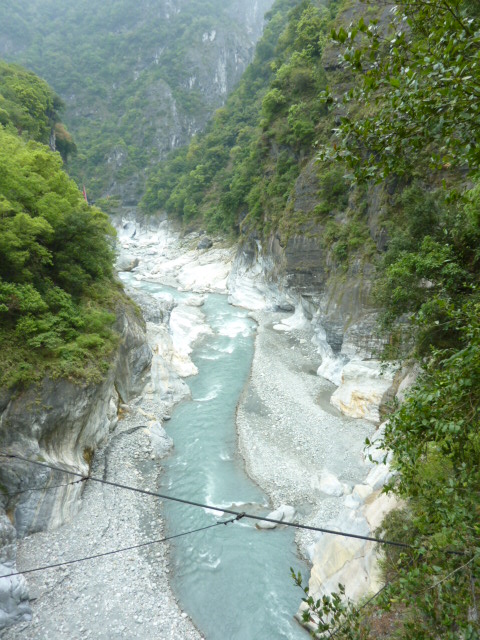 If you do stop, this is your view.
 As you go up the mountain, there are many switchbacks, of road and river.
 At the end of the day, this was our last stop at a temple. We almost got locked in because we didn't understand their instructions to us that they would be locking up soon.
 As we climbed steps up to the temple we saw this river bed with large stones carried down by the monsoon rains. At the base of the mountain we saw even bigger stones "harvested" from the rivers beds and collected in lots (for sale, I guess).
 Here was one statue.
 And another.
 Here is the inside of the temple where they burn incense.
 Nearby is a pagoda...
 ...which is meant to be climbed, right?
 Inside, this is your view looking up.
 And this is your view looking down.
 And this is the view of the temple from the top floor.